Thursday, January 21, 2010

Rise and fall of Vijayanagar - The Hindu Kingdom - 8


Vijayanagar - The Fabled City :

It was said that "All roads lead to Rome"! Such was the beauty and marvel of that city. Domingo Paes of Portugal exclaimed after seeing the city of Vijayanagar - "I am seeing a city bigger than Rome and the most richest and splendid city on Earth"! The city was spread over an area of 60 Sq. Kms with a picturesque backdrop of huge mountains. It required more than three days to have a glimpse of the city even if travelled on a horse. The city of Vijayanagar had overtaken all the economic centres of the World. It had grown into a Cosmopolitan, metropolitan and a Pluralistic city of the World 500 years ago. It was the most envied and visited World trade centres.

Travellers, traders, educationists, Phlosophers, historians, from all over the world would come and have a glimpse of the most popular city and in an AWE would narrate, describe and write chronicles over the marverl, splendour, grandeur and majesty of the city of Vijayanagar.

Another traveller describes the city thus - "the eyes of the pupil have never seen and the ear of intelligence have never heard of such a city".

Internal security was given prime importance. The city was protected by seven rounds of fort. Each round was secure in hands of soldiers who stood in protection and everyone was invariably checked before entering the city and it was the same for all seven rounds of fort. Krishnadeva Raya`s army comprised of 10 lakh soldiers, 32000 cavalry and 550 elephants. The largest army held by a Hindu ruler. The army was equipped with the most sophisticated weapons of that time. They had in their army, horses from Persia, canons from Europe and Turkey.

Economy:

The economy of Vijayanagar cannot be just explained through the Share and stock indices of modern day times. The riches of the city attracted travellers from all over the world. Krishnadeva Raya not only managed his resources efficiently but dictated trade terms on Portuguese and Persians. The markets of vijayanagar consisted of stalls selling Jasmine and Roses. The People of Vijayanagar loved flowers more than anything else is what another traveller opines.

Nowhere in the world has been seen that the vendors sell rubies, pearls, gold, silver, emerals, ornaments and diamonds on road side !! But that was the case with Vijayanagar. Women could wear ornaments and go out of their houses even during night times. When the riches is of such highscale, obviously the standard of living and the Moral values of people would be par excellence, leave alone the GDP and the Per capita Income.

The items of trade included cotton, quick silver, copper, Gold, rubies, pearls, diamond, Horse trade with Persia, weapons, areca nut, coconut, pepper, cashew, sugarcane, rice, wheat, jowar, barley etc,. The trade relations spread from Red Sea to Mecca, Aden, Venice, China(silk), Burma(Cotton), Java and Sumatra(clothes), Elephants were purchased from Srilanka thus touching the Nooks and corner of the Globe. Every year One Crore Gold coins were added to the treasury and the King would not use even a single rupee for his or to the benefit of his family. Such high moral standards were set and followed by the King himself. Land revenue was the main source of income along with agricultual taxes. The taxation system was called RAYAREKHA, the taxes were imposed as per the yield of every farmer. The ports on the east and west coast added 240 crore rupees every year through sea trade. Krishnadeva Raya was bestowed with the title - Poorva Paschima Samudradhipathi ( Master of east and west coast)

Such was the economic condition of Vijanayangar. Worthy to note that the personal wealth ammased by Robert Clive from the blunder of Bengal was estimated at around 401,102 pounds. Total amount of treasure looted by British was one Billion pounds by the year 1901. Taking into consideration Interest rates and the inflation rates, this would be worth close to one Trillion pounds in real terms today. (One trillion = One lakh crore Indian rupees) !!. And the total debt of India for the financial year 2008 is 19.57 trillion rupees. From Riches to Rags.

Irrigation :

Irrigation was given top priority. No wonder every King gave much importance to Irrigation and agriculture, water conservation and rain water harvesting. Krishnadeva constructed several lakes and canals which can still be seen. They are even today called Rayakaluve(Raya`s canals). The British records show that he was the first to use Dynamites. The farmers of Vijayanagar had developed some unique seeds that would give yield within three months.

Architecture and Temples:

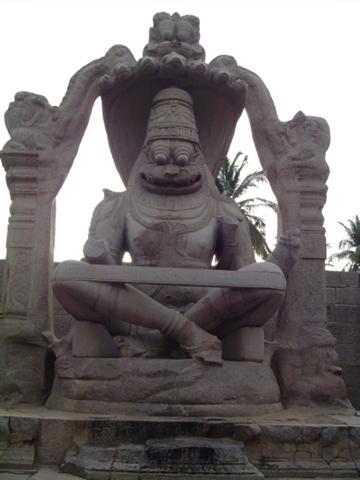
Krishnadeva took up the task of restoring temples of Srirangam, Kalahasthi, Tirupathi and Madurai. They were named Raya Gopuram in memory of Rayas(kings) of Vijayanagar. Many temples like Hajara Rama, virupaksha, vijaya Vithala were built during this period. The witness to the spledid architectural marvel of the empire still stands in the form of the Stone Chariot, Ugra Narasimha Idol and the Musical Pillars of Hampi.

Due to Islamic agression the temples of Vijayanagar took shape of the fort. Krishnadeva practically built very less temples during his reign but ensured the safety and sanctity of existing temples. During his reign of 21 years no temple was even touched by Jihadis.

Administration :

The state was divided into several administrative areas such as Pranth, rajya, mandal. The system of administration was decentraliized. Everything was village centred. The head of the unit was called Mahanayakacharya. Even though the king was supreme power in deliveing justice there were local officer who would, at times give judgement. The cases were immediately attended and suitable action taken. Criminal offenses would fetch the offender a severe punishment. Everyone had access directly to the King.

Even though the king was Hindu, he treated all faiths with equal reverence. Jews, Portuguese, Muslims were given due respect and Muslims enjoyed their status in his army. Vaishnava Krishnadeva saw all castes that dwelled in his state with utmost reverence. His Royal flag had the emblem of Varaha and his Royal signature had the emblem of Virupaksha. The king along with his minister would go in the Guise of a commoner to have a glimpse of his people.

Rise and fall of Vijayanagar - The Hindu Kingdom -7


Unique features of Krishnadeva Raya`s political conquests:

In the long history of battles that the world has seen, heard and endured, the ones that have involved Islam and Christianity have been the most bloodiest. Atleast in the Modern era. That too when it is motivated by Semitic ambitions.

India too has seen wars. Since SATYAYUGA !! But nowhere it can be seen, traced nor heard that the Hindu soldiers have destroyed a culture, a civilization and have imposed Hindu faith upon the conquered. In this long history, only two soldiers have remained undefeated. One is Shivaji and the other is Krishnadeva Raya!! Proud to be their posterity.

Very important feature of Krishnadeva`s conquest was that most of his wars were fought away from his capital. He had to travel lengthy distances from his capital and fight enemies in their own territory. The battle of Raichur and Orissa will stand as the most risky and calculative of his wars. He, along with his troops, had travel for over 1000 Kms. He had to carry with him weapons, canons, horses, elephants. At that time his was the largest army in India, comprising of 10 lakh foot soldiers, 32,600 cavalry and 550 elephants. To provide for such a vast army during war was another herculean task. Ten to twelve thousand soldiers would march ahead of the army and find water sources and arrange for food and shelter. No one could predict how long the war would go. And most risky factor was to protect the capital from enemies when his army is engaged in war. He was all successful in whatever step he took. Truly, an undefeated King of the History !!

Rise and fall of Vijayanagar - The Hindu Kingdom - 6

Krishnadeva Raya`s political conquests :

From day one it was not a cake walk for Krishnadeva Raya. His brother had strained relations with the tributaries of the Kingdom and his trade relations were also not healthy. Krishnadeva first emphasized on cementing relations with the subsidiaries of the empire and improve trade relations. He was not only successful in his initial venture, he actually made all small rulers submit before him and brought them under one Rule and ruler. He not only improved trade relations with the portuguese and Persians but he dictated the trade terms on them. He was all the more supreme and unarguably the emperor of the whole of south India. His conquests began from Ummattur. He defeated Gangaraja over there amidst strong resistance. This helped him in gaining confidence of all small rulers under him.

The most ferocious of the wars that Krishnadeva fought is said to be that of Raichur battle. A small incident led to such a huge war. Syyed Markar was a soldier of Krishnadeva`s army. He was handed some money and was sent to purchase Horses from Goa. He betrayed Krishnadeva and escaped to Adil shah of Bijapur. Adil shah did not heed to the request letter sent by Krishnadeva, asking him to handover Syyed Markar. Furious over this attitude of Adil shah, Krishnadeva ordered his troops to get ready to fight him out and restore his pride. He was not only a brave soldier but a shrewd thinker and a great strategist as well. He thought that Adil shah would come in rescue of Raichur fort, if he attacked Raichur instead of Bijapur. Exactly the same happened and Adil shah arrived with his army in rescue of Raichur fort.

Ferocious battle took place between the two. Initial honors went to Adil shah and the brutality was of such magnitude that Krishnadeva`s army almost turned its back to the war. Krishnadeva addressed them and infuriated them with the sense of National pride and asked them to FIGHT UNTO VICTORY. The troops fought in such a way that Adil shah thought of saving his life rather than winning the Fort. He fled from the battle field. This great victory saw Krishnadeva Raya as the sole emperor of South India and the saviour of Hindu Dharma.

The victorious troop entered the city of Raichur and Krishnadeva promised the people over there and left them with the choice of leaving the city or to accept the Hindu rule henceforth. He did not allow any of his soldiers to loot or destroy the city. All the loot was handed over to its original owners. He assured the people that no lives will be damaged. Natural for a true Hindu King.

Akbar after winning the fort of Chittod, did not stop there, and killed more than 30000 people in a single day. And unfortunately he is bestowed with the title- GREAT. Who really is Great?

Krishnadeva`s victory march continued through Udayagiri, Mudkal, Kondapalli, cuttack. His kingdom, the Hindu Kingdom now stretched from Goa to Andhra and Kanyakumari to Orissa. He conquered Orissa which was ruled by Pratap Rudra Gajapathi. He was pardoned and was made king again and declared that he acted as subsidiary to Vijayanagar. Krishnadeva married his daughter Jaganmohini as well, leaving no room for Pratap whatsoever to intrigue against him.

Rise and fall of Vijayanagar - The Hindu Kingdom - 5

Krishnadeva Raya (1509-1530):

In the brief history of Vijayanagar that spanned for 229 years, Krishnadeva Raya was unarguably the most successful King. The time and situation at which he took the reigns and the way he lead the army into victory and the subsequent achievements is in itself self explanatory to the towering personality of this great King of Vijayanagar.

He was given education that is required for a king to lead the country. He showed great promise that he became inevitable and unanimous choice to accede the throne of the most prestigious Empires of India.

Born to Narasanayaka and Nagaladevi in 1471, Jan 21st, he excelled in archery, artillery, horse riding, power lifting, fencing and was articulate in political sciences. He also showed exemplary talent in the field of literature, fine arts, music under the guidance of Sri Vyasaraya.

After his elder brother veera Narasimha nayaka, he took over the responsibility and led the Empire to the heights of glory. Under him the hindu kingdom reached the Pinnacles of Glory. The day he was asked to take charge of the Kingdom, it was engaged in a war and his brother was a martyr in that battle. Anyone can accept the charge when the state of affairs is running smoothly. But to lead the country when it is in crisis - it requires a real MAN.

His day would begin as early as 3.30 A M. He started his routine by bending himself to the limits of physical exercises such as horse riding, fencing, power lifting, wrestling and the likes. He was a fine blend of Kshatra and Bramha Tejas. After offering his daily prayers he would meet his prime minister Timmarasa and his close aides. Amidst all this he took sometime everyday for his family.

Those who met him even once were invariably inspired and impressed by his tremendous personality. Such was his stature. He was at the same time humble, polite and pleasing and strong, sturdy and firm in his decesions. Domingo Paes, a portuguese traveller describes Krishnadeva Raya thus - "the most feared and the perfect king that could possibly be"

Rise and fall of Vijayanagar - The Hindu Kingdom - 4

Vidyaranya - A Saint and a true Nationalist :

One of the historan says "Vidyaranya was the first to identify Islam as the idea of Imperialism". Thus a man with rare insight and vision was responsible for establishment of such a great kingdom. He, being a true nationalist made it clear to the men around him, on whom he entrusted to implement the idea of nationalism, that there was no need for creating an empire to assimilate economic riches nor there was any need to build an army to fullfil the capitalistic thirst of Royal families. He emphaised on four things before the Kingdom was established. 1. Restore Hindu Dharma. 2. Build strong forts to protect people. 3. Organize large army to fight Islamic onslaught. 4. Wipe out Islam from bharath.

Vidyaranya was born and brought up in an orthodox Brahmin family. His father Mayana, mother Srimathi, brothers Sayana and Bhoganatha, sister Singale all led a happy and content life. Children were given moral education along with the regular text book studies. Children were also given liberty to choose the field of education of their interest. Not a well to do family, but they were earning sufficiently to lead a life of respect and independence. Vidyaranya was well-verse in sanskrit and could recite Vedas. He knew to play veena, flute and other Musical instruments. He also excelled in the field of fine arts. Gifted with a rare insightful vision, Vidyaranya had an eye on what was happening around the country. He could diagnose the situation and could evolve suitable solutions.

A scholar has to be a nationalist. His intellect should not be overshadowed by temporary emotional outburst, but it should translate into wise social and political moves. Vidyaranya was such a nationalist personified. He worked at he grass-root levels to organize and create awareness among Village sarpanch. He used Temple reserves for social and national causes such as irrigation, education and defense etc. This is regarded as the revolutionary work at that time, that too for a man hailing from a orthodox family.

He was a minister to Hakka and Bukka. It is said that he lived for 91 years. Before brething his last he took Sanyasa at Shringeri. He also contributed to the field of literature and nowhere in his works one could find the hatred for other faiths. Before bidding adieu to his Motherland he was cocksure of his vision being put to action and the mission being accomplished. Hakka and Bukka blossomed as great kings under his guidance and blessings and laid a strong foundation for the most celebrated Kingdoms of Indian History.

Rise and fall of Vijayanagar - The Hindu Kingdom - 3

Early days of the Empire :

Across the Banks of Tunga lies Anegundi. Vijayanagar was established by the name Vidyanagar and later came to be known as Vijayanagar. It was initially a small township with the picturesque backdrop. First rulers of the kingdom stressed on rehabilitation of the town, cementing relations with the tributaries of Kingdom, bringing all small rulers under one roof, restoring the temples of Madurai, Srirangam, Kalahasti etc.

Sayanacharya, brother of Vidyaranya was assigned with the laborious job of writing commentary on Vedas . His works stand as authority even today.

Hakka was the first king. He ruled for a brief period of 7 years (1336-1343) and laid a strong foundation for posterity. After him Bukka took over the reign and expanded the kingdom over good parts of southern India. Some of the forts which were held by muslims were recaputred, thus gaining confidence of small Hindu rulers. Seeing this all small rulers submitted before Vijayanagar kingdom and came united under one Hindu ruler and rule.

Earlier Chanakya and Chandragupta had adapted similar strategy to counter Alexander. The Greek king was able to penetrate the borders just because all the kings and rulers of that part were divided and had declared themselves as Independent sovereign kings. They were easily defeated and thus the borders were open for Alexander. Chandragupta united all of them under one rule.

The history as it is said - Repeats itself. Under the rulers of Vijayanagar the history of Hindu rulers was about to repeat and they would now live with their head held high and swollen chest.

The rise and fall of Vijayanagar - The Hindu Kingdom - 2

The Idea of Vijayanagar :

As already mentioned the Islamic conquest had almost spread throughout the globe and muslims were the most feared Race on Earth. Wherever they stepped, they looted, plundered and destroyed the civilizations and diversity as a whole.

Though it was a not a cake walk for Islam in India, yet they were successful in establishing themselves through the length and breadth of half of India.

When the idea of Establishing a Kingdom and organizing an army sprouted in the minds of Vidyaranya and Veera Ballala they were in no Dilemma over the Motto behind the Establishement. It was obvioulsy and unanimously decided in the meeting of Tiruvannamalai that the very meaning of establishment of the Kingdom would be to 1. Restore and protect Hindu Dharma. 2. Build strong army 3. Fight Islamic onslaught. Nowhere in the minds of these men lingered a slight doubt or did they think otherwise of creating an empire with economic and military might, or to quench the capitalistic thirst of the Royal families. The Idea was absolutely clear. Save, restore and protect Hindu dharma.