Vijayanagar - The Fabled City
 :
It was said that "All roads lead to Rome"! Such was the beauty and marvel of that city. Domingo Paes of Portugal exclaimed after seeing the city of Vijayanagar - "I am seeing a city bigger than Rome and the most richest and splendid city on Earth"! The city was spread over an area of 60 Sq. Kms with a picturesque backdrop of huge mountains. It required more than three days to have a glimpse of the city even if travelled on a horse. The city of Vijayanagar had overtaken all the economic centres of the World. It had grown into a Cosmopolitan, metropolitan and a Pluralistic city of the World 500 years ago. It was the most envied and visited World trade centres.
Travellers, traders, educationists, Phlosophers, historians, from all over the world would come and have a glimpse of the most popular city and in an AWE would narrate, describe and write chronicles over the marverl, splendour, grandeur and majesty of the city of Vijayanagar.
Another traveller describes the city thus - "the eyes of the pupil have never seen and the ear of intelligence have never heard of such a city".
Internal security was given prime importance. The city was protected by seven rounds of fort. Each round was secure in hands of soldiers who stood in protection and everyone was invariably checked before entering the city and it was the same for all seven rounds of fort. Krishnadeva Raya`s army comprised of 10 lakh soldiers, 32000 cavalry and 550 elephants. The largest army held by a Hindu ruler. The army was equipped with the most sophisticated weapons of that time. They had in their army, horses from Persia, canons from Europe and Turkey.
Economy:
The economy of Vijayanagar cannot be just explained through the Share and stock indices of modern day times. The riches of the city attracted travellers from all over the world. Krishnadeva Raya not only managed his resources efficiently but dictated trade terms on Portuguese and Persians. The markets of vijayanagar consisted of stalls selling Jasmine and Roses. The People of Vijayanagar loved flowers more than anything else is what another traveller opines.
Nowhere in the world has been seen that the vendors sell rubies, pearls, gold, silver, emerals, ornaments and diamonds on road side !! But that was the case with Vijayanagar. Women could wear ornaments and go out of their houses even during night times. When the riches is of such highscale, obviously the standard of living and the Moral values of people would be par excellence, leave alone the GDP and the Per capita Income.
The items of trade included cotton, quick silver, copper, Gold, rubies, pearls, diamond, Horse trade with Persia, weapons, areca nut, coconut, pepper, cashew, sugarcane, rice, wheat, jowar, barley etc,. The trade relations spread from Red Sea to Mecca, Aden, Venice, China(silk), Burma(Cotton), Java and Sumatra(clothes), Elephants were purchased from Srilanka thus touching the Nooks and corner of the Globe. Every year One Crore Gold coins were added to the treasury and the King would not use even a single rupee for his or to the benefit of his family. Such high moral standards were set and followed by the King himself. Land revenue was the main source of income along with agricultual taxes. The taxation system was called RAYAREKHA, the taxes were imposed as per the yield of every farmer. The ports on the east and west coast added 240 crore rupees every year through sea trade. Krishnadeva Raya was bestowed with the title - Poorva Paschima Samudradhipathi ( Master of east and west coast)
Such was the economic condition of Vijanayangar. Worthy to note that the personal wealth ammased by Robert Clive from the blunder of Bengal was estimated at around 401,102 pounds. Total amount of treasure looted by British was one Billion pounds by the year 1901. Taking into consideration Interest rates and the inflation rates, this would be worth close to one Trillion pounds in real terms today. (One trillion = One lakh crore Indian rupees) !!. And the total debt of India for the financial year 2008 is 19.57 trillion rupees. From Riches to Rags.
Irrigation :
Irrigation was given top priority. No wonder every King gave much importance to Irrigation and agriculture, water conservation and rain water harvesting. Krishnadeva constructed several lakes and canals which can still be seen. They are even today called Rayakaluve(Raya`s canals). The British records show that he was the first to use Dynamites. The farmers of Vijayanagar had developed some unique seeds that would give yield within three months.
Architecture and Temples:
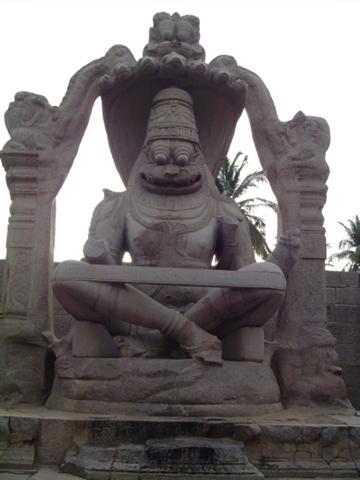
Krishnadeva took up the task of restoring temples of Srirangam, Kalahasthi, Tirupathi and Madurai. They were named Raya Gopuram in memory of Rayas(kings) of Vijayanagar. Many temples like Hajara Rama, virupaksha, vijaya Vithala were built during this period. The witness to the spledid architectural marvel of the empire still stands in the form of the Stone Chariot, Ugra Narasimha Idol and the Musical Pillars of Hampi.
Due to Islamic agression the temples of Vijayanagar took shape of the fort. Krishnadeva practically built very less temples during his reign but ensured the safety and sanctity of existing temples. During his reign of 21 years no temple was even touched by Jihadis.
Administration :
The state was divided into several administrative areas such as Pranth, rajya, mandal. The system of administration was decentraliized. Everything was village centred. The head of the unit was called Mahanayakacharya. Even though the king was supreme power in deliveing justice there were local officer who would, at times give judgement. The cases were immediately attended and suitable action taken. Criminal offenses would fetch the offender a severe punishment. Everyone had access directly to the King.
Even though the king was Hindu, he treated all faiths with equal reverence. Jews, Portuguese, Muslims were given due respect and Muslims enjoyed their status in his army. Vaishnava Krishnadeva saw all castes that dwelled in his state with utmost reverence. His Royal flag had the emblem of Varaha and his Royal signature had the emblem of Virupaksha. The king along with his minister would go in the Guise of a commoner to have a glimpse of his people.